REVIEW · FLORENCE
Florence By Night 2-hour Walking Experience
Book on Viator →Operated by Hidden Experiences · Bookable on Viator
Florence by night feels different fast. This 6:30 pm walk helps you see Florence after dark while the daytime crowds and heat loosen their grip, and I love how the route ties major sights to how the city actually worked. You also get a real advantage from the headphones, which lets you keep moving without missing the guide’s commentary. One watch-out: if the evening is still bright and sunny, you may not get peak sunset-style photos.
This is the kind of tour that works well on your first or second evening, when you still need the map in your head. Guides like Elisabet, Ivan, Francesca, Steph, and Jack are repeatedly praised for lively delivery, plus a helpful mix of architecture, power politics, and street-level details. If you prefer a super-slow pace with lots of free time to browse, this isn’t that kind of stroll—it’s a guided walk with a set rhythm.
In This Review
- Key things that make this Florence night walk worth it
- Why a 6:30 pm Florence Walk Is a Smart Timing Choice
- Piazza della Repubblica: Starting on the Risanamento Square
- Santa Maria del Fiore, Giotto, and the Baptistery Area at Dusk
- Piazza della Signoria and Palazzo Vecchio: The Medici Political Power Center
- Uffizi Gallery and the Vasari Corridor: Art, Offices, and a Planning Trick
- Headphones, Small Groups, and the Guides Who Keep It Fun
- What You’ll Feel During the 2 Hours: Pace, Photos, and Comfort
- Value and Who Should Book This Florence Night Walk
- Should You Book Florence By Night?
- FAQ
- What time does the Florence by Night walking experience start, and where is the meeting point?
- How long is the tour?
- Is the tour offered in English?
- Is this a small group, and are headphones included?
- What’s included in the price?
- What’s not included?
- What cancellation options are available?
- FAQ
- What physical fitness level do you need?
Key things that make this Florence night walk worth it
- A night route that fights the day crowds so landmarks feel more breathable
- Headphones keep the story clear while you’re walking past major sites
- Small group size (max 15) for a more personal, less chaotic feel
- A Medici and power-politics storyline rather than random facts
- Duomo-area views without peak heat at the end of the day
- English-speaking licensed guide with on-the-spot context
Why a 6:30 pm Florence Walk Is a Smart Timing Choice
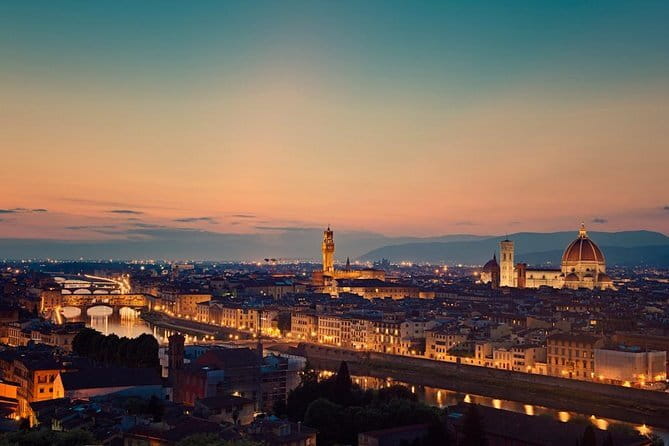
The big win here is the timing. A 6:30 pm start puts you in that sweet spot where you’re not walking in midday sun, but you’re also not stuck waiting for late-night hours. In practical terms, that means your feet do less suffering and your brain can actually absorb the city.
This is also a good way to get your bearings. Florence’s center can feel tight and confusing in daylight, even when you think you know where you’re going. At night, streets narrow into a more cinematic grid, and the guide’s route helps you connect big landmarks to the smaller lanes between them.
The tour lasts about 2 hours, so it’s long enough for a meaningful sweep but short enough that you won’t feel like you missed dinner. If you’re the type who likes to end tours with a gelato plan, that works too—guides are known for offering practical suggestions right after.
You can also read our reviews of more evening experiences in Florence


Piazza della Repubblica: Starting on the Risanamento Square
The walk starts at Piazza della Repubblica, a central place where Florence’s planning history shows up right away. One of the coolest things about this start is that you’re not beginning at a “pretty postcard” point. You’re beginning at a square shaped by urban redesign—when Florence was reorganizing itself and redefining how the city would function as the capital.
That matters because it frames your night. If you only look at Florence as art and towers, you miss the city behind the art. Starting here sets you up to hear how Florence moved from one era to the next—how public space, political presence, and culture got layered on top of each other.
At night, the square also behaves differently than during the day. It’s less about rushing through and more about noticing. You can see how major routes funnel people toward the historic core, and you get your first easy landmarks for orientation before heading toward the Duomo area.
Practical tip: since this is a walking experience with moderate fitness needed, I’d wear shoes that handle cobblestones comfortably. Your first stop is a good time to get settled and find the headphone fit.
Santa Maria del Fiore, Giotto, and the Baptistery Area at Dusk
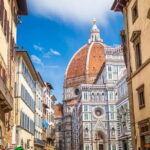
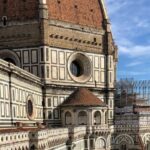
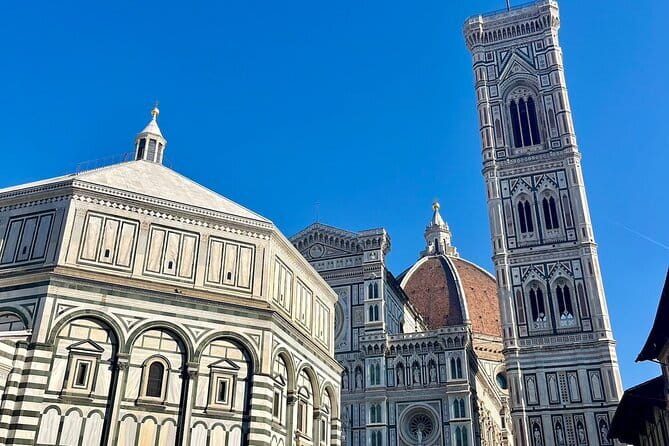
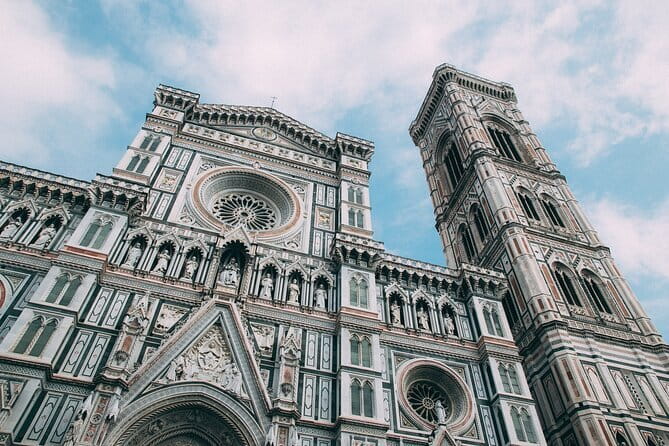
Next you move into the heart of the historic center, where Santa Maria del Fiore (the Duomo), Giotto’s bell tower, and the baptistery of San Giovanni dominate the skyline. Even if you’ve seen these on photos, the night adds a new kind of depth. Details don’t vanish—they shift. Edges and silhouettes become easier to read, and the guide can connect what you’re seeing to why it was built the way it was.
This is also a smart stop for comfort. By the time you reach this area, you’re coming off the hottest part of the day for many travelers. The result is that you can focus on listening and looking instead of battling heat.
What I like about this section is that it feels like more than sight-seeing. The Duomo complex is famous, yes, but it’s also a symbol of how Florence expressed power through religion and civic pride. A good guide helps you notice relationships: the scale, the placement, and how this cluster of buildings anchors the entire city narrative.
If you’re the photographer in your group, here’s the consideration: in early evenings that are still bright, sunset-style shots may be harder. You’ll still get good views—just manage expectations for dramatic sky colors.
Piazza della Signoria and Palazzo Vecchio: The Medici Political Power Center
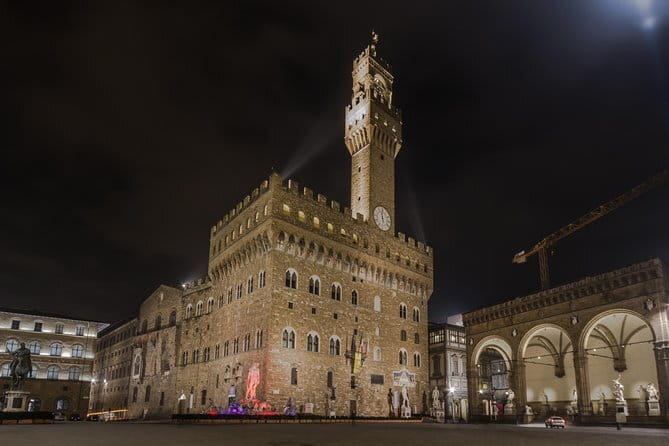
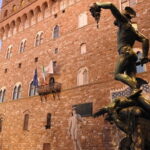
From there, the tour heads to Piazza della Signoria, where the seat of the Municipality sits—and where Duke Cosimo I de’ Medici made it his residence and political hub once the Medici moved to Palazzo Pitti. That one detail changes how the square feels. Instead of seeing it as a scenic plaza, you start seeing it as a stage where decisions happened.
This is one of those Florence stops where architecture and politics overlap. You’re walking through space that was used to project authority. When the guide explains the Medici connection, it helps you understand why Florence’s public squares feel so intentional, not accidental.
Night works well here because the square becomes more about presence. You’re not just passing through on your way to something else; you’re standing in a place that was designed for visibility. Even if you don’t remember every fact, you’ll likely remember the feeling: Florence at night is calmer, but power still reads in the space.
If you want to keep building the story after the walk, this is also a strong area to revisit under your own pace. You’ll know where you are, and you’ll know what to look for.
Uffizi Gallery and the Vasari Corridor: Art, Offices, and a Planning Trick
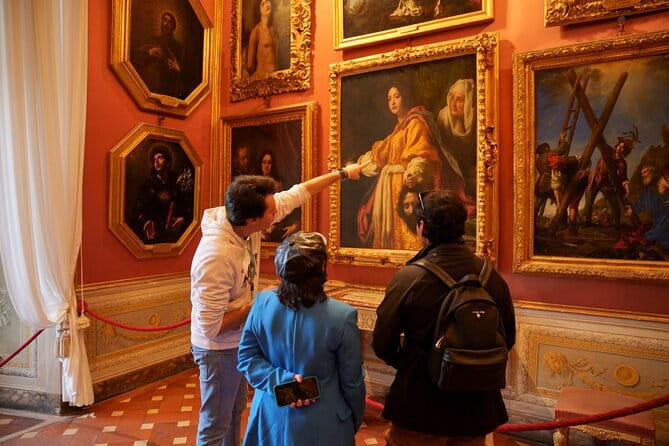
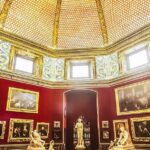
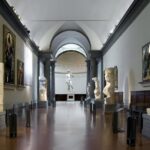
The final major stop points toward the Uffizi Gallery, described as one of the most important museums in the world. You’ll also hear why it’s special beyond its name: it houses the largest existing collection of Raphael and Botticelli, and it links directly back to the Medici offices. There’s also a fascinating thread about how the Vasari Corridor starts here.
Even if you don’t go inside during the walk, this is still a valuable moment. The Uffizi is a magnet for obvious art interest, but what makes this tour stop work is the way it connects art collecting, administration, and movement through the city. You get a clearer sense that Florence’s masterpieces didn’t appear in a vacuum. They were managed, financed, and housed within a larger system of Medici power.
The Vasari Corridor detail is especially compelling because it gives you a “city puzzle” to notice later. It’s the kind of thing that makes you look at streets and buildings with more curiosity after the tour ends.
After this stop, you’ll be well-positioned to plan your next move—whether that’s booking museum time, wandering nearby lanes, or just staying in the area longer because you understand how the pieces connect.
You can also read our reviews of more tours and experiences in Florence


Headphones, Small Groups, and the Guides Who Keep It Fun
This experience is built for listening while walking. Headphones are included for participants from 10 people onward, and that’s a big deal in a city like Florence. Without headphones, you’d constantly have to choose: stand still to hear the guide or move on to keep your place in the group. With headphones, you can do both.
You’ll also be in a small group. The tour runs with a maximum of 15 travelers, and that limit helps keep the walk from turning into a slow-moving crowd line. In practice, it often means the guide can pace for people, not for a huge bottleneck.
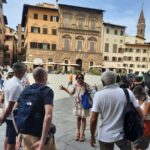
Guides have a reputation for engagement and flexibility. Names that come up include Elisabet, Ivan, Francesca, Steph, and Jack. What connects them is the delivery style—enthusiastic storytelling, architecture that makes sense, and humor that breaks up the facts. Some guides even help you extend the night with suggestions for other activities and food stops, which is exactly what you want when you’re trying to enjoy your first days in town.
One last practical note: since it’s an English tour, you’ll want to make sure your listening setup feels comfortable before the walk gets underway. Once you’re rolling, the story moves with you.
What You’ll Feel During the 2 Hours: Pace, Photos, and Comfort
A two-hour walking tour is a sweet spot, but you still need to plan like it’s real walking. The tour is described as requiring a moderate physical fitness level, which usually means expect steady walking on uneven surfaces. Florence’s center is beautiful, but it’s not flat, and it’s not always smooth.
Pace-wise, you’ll likely spend time at each stop but not enough to fully browse. This is a guided overview experience. You’re meant to come away with context and a mental map, then choose what to explore later on your own.
For photos, think in terms of night ambience rather than guaranteed sunset color. If your night is clear and the light is still strong at 6:30 pm, you may see bright shadows rather than dreamy twilight. Still, Florence at night gives you softer contrasts, and lit stone can look fantastic for close-up architectural shots.
The best comfort strategy is simple:
- wear supportive shoes
- bring a light layer if evenings feel cool to you
- keep your phone charged, because you’ll want it after the walk
Value and Who Should Book This Florence Night Walk
At $52.98 per person for about two hours, you’re paying for three things that matter in a crowded city: a licensed guide, headphones that make the experience easier to follow, and a structured route that hits high-impact landmarks. You’re also getting group discounts and a mobile ticket, which helps keep things smooth when you arrive.
Is it a bargain? For Florence, yes—especially if this is your first time and you want an organized way to understand what you’re seeing. If you already know Florence well and want unstructured museum time, it may feel too light. But if you want a fast, high-signal introduction to the city’s major sites and the Medici story connecting them, it’s a strong match.
This is also a great “early trip” choice. It helps you get oriented before you commit time to bigger museum days. If you tend to get overwhelmed by guidebooks, this kind of guided walking makes your first night easier. If you like small group energy, you’ll likely appreciate the cap of 15.
If you’re deciding between an afternoon and this evening plan, I’d choose this for comfort and story value. The main trade-off is that some of your photos may be less dramatic than you hoped on particularly bright evenings, but the city’s atmosphere at night usually makes up for it.
Should You Book Florence By Night?

Book it if you want an efficient, story-led way to see Florence’s core after dark. It’s especially worth it for first-time visitors, couples, and small groups who want a guided map of the Duomo area, Medici power sites, and the Uffizi context without spending the whole night in a museum line.
Skip it only if you hate walking, want long unstructured breaks at every stop, or you’re looking for a museum admission experience inside the buildings during the tour. This is a guided walking night, not a full ticketed museum day.
FAQ
What time does the Florence by Night walking experience start, and where is the meeting point?
It starts at 6:30 pm and meets at Piazza della Repubblica, 50123 Firenze FI, Italy. The tour ends back at the meeting point.
How long is the tour?
The experience lasts about 2 hours.
Is the tour offered in English?
Yes, it is offered in English.
Is this a small group, and are headphones included?
The tour is a small group with a maximum of 15 travelers. Headphones are included for participants starting from 10 people.
What’s included in the price?
Included are a licensed tour guide, headphones (from 10 participants), and a small group guided tour.
What’s not included?
Not included are gratuities (optional), food and drinks, and hotel pick-up/drop-off (optional with an extra charge), plus any extras.
What cancellation options are available?
You can cancel for a full refund up to 24 hours before the experience’s start time (based on local time), and free cancellation is available.
FAQ
What physical fitness level do you need?
You should have a moderate physical fitness level for this walking experience.
You Might Also Enjoy

More 2-Hour Experiences in Florence
More Evening Experiences in Florence


More Tour Reviews in Florence
- Tuscany Day Trip from Florence: Siena, San Gimignano, Pisa and Lunch at a Winery
★ 5.0 · 21,634 reviews - The Best tour in Florence: Renaissance & Medici Tales – guided by a STORYTELLER
★ 5.0 · 12,316 reviews