REVIEW · FLORENCE
Essential Florence Walking Tour with an Expert Local Guide
Book on Viator →Operated by Walkabout Florence Tours · Bookable on Viator
Florence clicks into place after a tight guided walk. This Essential Florence Walking Tour strings together major landmarks with clear explanations and human stories, from Medici power to the city’s religious center. Guides like Andrea, Becky, and Lisa are singled out in past groups for making the details easy to follow, not like a textbook.
What I really like is the value for time. For about three hours, you move through an impressive range of sites and eras, with built-in time for bathroom breaks and even a short rest/coffee moment reported by some groups. You also get a local gelato stop as you stroll the cobblestones, so it feels like sightseeing, not just standing and staring.
One thing to consider: the schedule is compact. With many stops and short visits, it’s ideal for getting oriented, but it’s not designed for deep museum time. If you dislike crowds or want a slow, sit-down pace at every church and palace, you may wish you had a longer itinerary.
In This Review
- Key points before you go
- Why This 3-Hour Florence Walk Works on First Visits
- Meeting at Piazza della Repubblica, Ending Near Piazza della Signoria
- Orsanmichele: From Grain Loggia to Sculpture Museum
- Museo Casa di Dante: A Shortcut Into Dante’s Florence
- Duomo (Santa Maria del Fiore), Baptistery, and Giotto’s Bell Tower
- Santa Maria Novella and the Logic of Church Architecture
- Palazzo Rucellai and Palazzo Strozzi: Renaissance Power in Stone
- Santa Trinita Frescoes and the Oltrarno Shift
- Palazzo Pitti: Medici to Grand Dukes to Royal Palace
- Church of Santa Felicita: Quiet Time Between Big Names
- The Vasari Corridor: A Medici Escape Route in the Sky
- Gelato, Bathroom Breaks, and Why Comfortable Shoes Are Non-Negotiable
- Price and Value: What $40.12 Buys You in Real Terms
- Who This Tour Is Best For (and Who Should Look Elsewhere)
- Should You Book This Essential Florence Walking Tour?
- FAQ
- How long is the Florence walking tour?
- Where does the tour start and end?
- What is the price per person?
- How big are the groups?
- Is gelato included?
- Which main sights will we visit?
- What happens if the weather is bad?
- Can I cancel for a full refund?
- Are admissions included for the listed stops?
Key points before you go
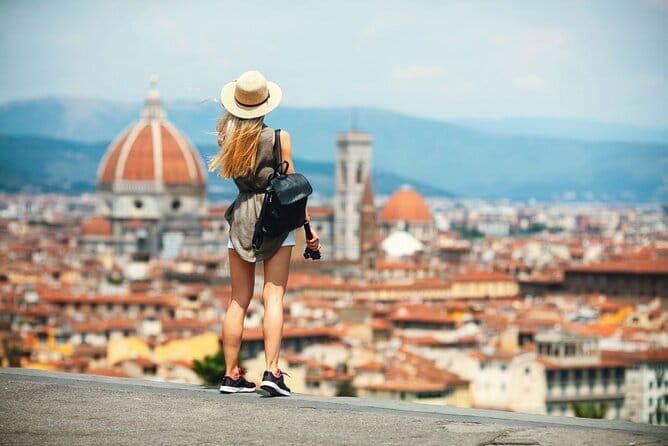
- A focused 3-hour route that hits cathedral landmarks, Renaissance palaces, and Oltrarno highlights without feeling like a marathon
- Free admission listed for each stop, so your main cost is the tour itself
- Gelato included while you walk through Florence’s most photogenic neighborhoods
- Small groups matter: the tour caps at 20, and some departures run very small
- Breaks are built in, including time for bathroom stops and a brief rest reported by past groups
- End in a powerful location near Piazza della Signoria, so you finish ready to explore on your own
Why This 3-Hour Florence Walk Works on First Visits
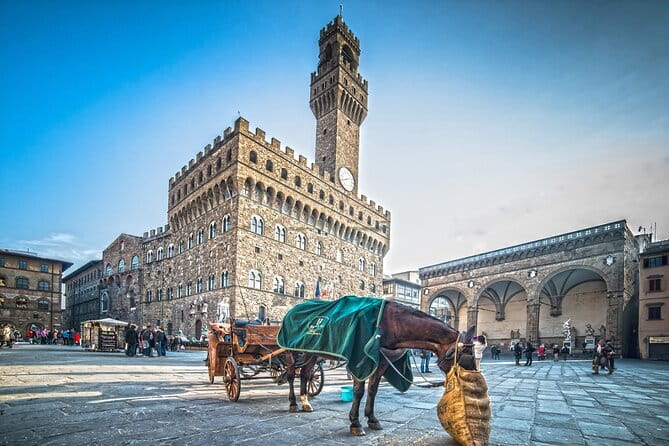
Florence can feel overwhelming fast. You’ll see domes, towers, palaces, and churches in the same hour, and if you’re not careful you end up with a blur of marble and dates. This tour is built to stop that problem.
The trick is the order. You start in the city center, then work through the Duomo complex area, move into major Renaissance architecture, and finish on the Oltrarno side with Medici-linked sights. Along the way, you get explanations that connect the pieces: who built what, why it mattered, and how Florence’s political and artistic life shaped the streets you’re walking.
Guides are a big part of the payoff. Past departures highlight Andrea, Becky, and Lisa for being engaging storytellers with strong local direction. That matters because many of these buildings are famous, but the why behind them is where the city turns from postcard to place.
You can also read our reviews of more walking tours in Florence
Meeting at Piazza della Repubblica, Ending Near Piazza della Signoria
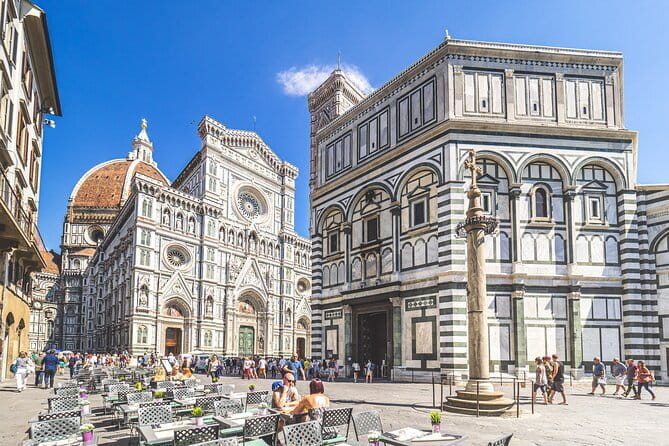
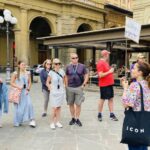
Your day starts at Piazza della Repubblica (near 9:00 am), then the route carries you toward the center of Florence’s most symbolic streets. The tour ends at Piazza della Signoria, one of the best launch points for evening wandering.
This end location is practical. Once you’re done with the guided route, you’re already positioned near major squares where you can:
- grab dinner nearby without backtracking,
- keep walking to adjacent streets with less guesswork,
- and follow your own curiosity (architecture, museums, people-watching).
It’s also the kind of layout that helps you plan the rest of your trip. After three hours, you usually know which neighborhoods you want to revisit and which sights you can skip without regret.
Orsanmichele: From Grain Loggia to Sculpture Museum
Stop 1 takes you to Orsanmichele, right in the heart of Florence. It began life as a loggia tied to storage and grain commerce, then shifted into a church associated with the arts and the ancient Florentine guilds. That transition is the first clue that Florence wasn’t just “art and beauty.” It was business, power, and faith all at once.
What you’ll focus on here is the connection between civic life and sculpture. The upper floors house a museum with originals from the sculptural cycle that once filled the niches outside, including famous works associated with Donatello and Ghiberti.
Why this stop is a smart opener:
- It gives you a model for how Florentines used public spaces.
- It sets you up to understand why later palaces and church art look the way they do.
Possible drawback: Orsanmichele is in the thick of the center, so you’ll want to stay aware of your belongings if you’re in busy lanes.
Museo Casa di Dante: A Shortcut Into Dante’s Florence
From there, you pass Dante’s house and spend time at the Museo Casa di Dante. The goal is simple: connect the author to the city that shaped him.
This isn’t presented as trivia. It’s more like a guided “life and work map.” You learn about Dante’s relationship with his city and why the places you’re walking past would have mattered to him.
Why it helps on a Florence trip: Florence is full of reminders of literature, politics, and identity—sometimes in subtle ways. This stop gives you a reference point so later churches, squares, and artworks make more sense.
Practical note: the time here is brief, so don’t treat it like a full independent museum visit. Instead, think of it as context before you zoom out again.
Duomo (Santa Maria del Fiore), Baptistery, and Giotto’s Bell Tower
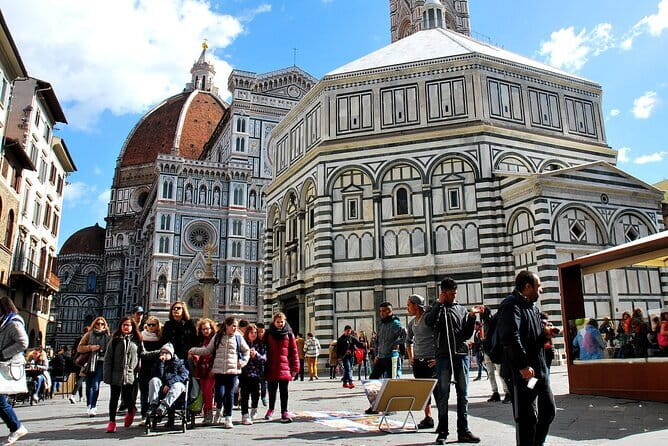
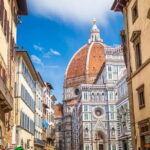
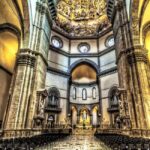
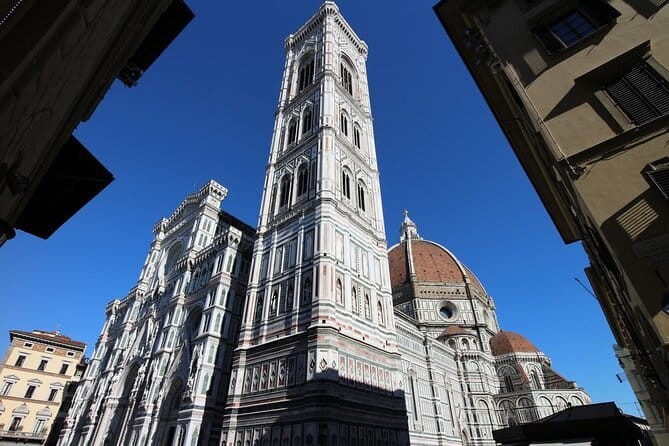
Stops 3, 4, and 5 cluster the most iconic religious landmarks in Florence: the cathedral of Santa Maria del Fiore (the Duomo), the Baptistery of St. John, and Giotto’s bell tower (Campanile di Giotto). This grouping is efficient and effective because the buildings “talk” to each other visually and historically.
At the Duomo area, the key idea is scale and ambition. When it was completed in the 15th century, it was the largest church in the world at the time, and it still holds a special place for the dome. You also hear how the site sits on older foundations, with worship happening there since Roman times.
Then you shift to the Baptistery of St. John, dedicated to Florence’s patron saint. For centuries, it was where Florentines obtained baptism, and it’s tied to investiture traditions for knights and poets—Dante was baptized here too.
Finally, Giotto’s bell tower stands in Piazza del Duomo as the cathedral’s bell tower. It’s a landmark you’ll see in photos all over the world, but the tour adds meaning: you learn how this architecture functioned in daily civic life, not just as a background for selfies.
Possible drawback: this is a crowded zone. Even with guide pacing, you’ll feel the density of central Florence. If you’re sensitive to busy spaces, plan to move slowly through the flow and keep your phone secured.
You can also read our reviews of more guided tours in Florence
- The Best tour in Florence: Renaissance & Medici Tales – guided by a STORYTELLER
★ 5.0 · 12,316 reviews
Santa Maria Novella and the Logic of Church Architecture
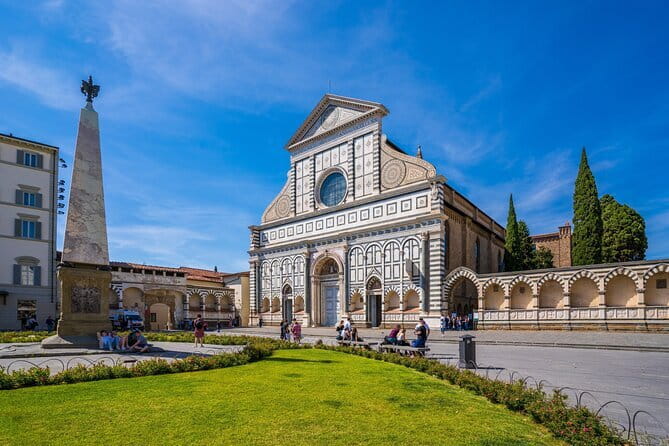
Stop 6 brings you to Santa Maria Novella, one of Florence’s important churches, located in the square of the same name. This is also tied to the Dominicans, and the tour frames it as a reference point for the mendicant order.
What you gain here isn’t only artistic interest. It’s a sense that Florence’s religious architecture helped organize community life. Churches weren’t just worship spaces; they were anchors for networks of learning, orders, and influence.
In a compact walking tour, churches can sometimes feel repetitive. This one avoids that by giving you the “why this church matters in Florence’s story” angle, so it doesn’t just blend into the background.
Palazzo Rucellai and Palazzo Strozzi: Renaissance Power in Stone
Stops 7 and 8 shift into Renaissance palaces, and this is where the city’s political side really starts to show.
Palazzo Rucellai is described as a 15th-century palace linked to Giovanni di Paolo Rucellai and designed by Leon Battista Alberti, executed in part by Bernardo Rossellino. What your guide points out is the facade logic: Renaissance architecture built with pilasters and entablatures in proportional relationships. In other words, it’s not random decoration. It’s a measured system that visually signals taste and status.
Then Palazzo Strozzi reinforces that theme on a larger scale. It’s one of the best-known Renaissance palaces, built after many buildings were destroyed to make room for it—15, according to the tour details. The palace is known for its imposing presence and symmetry, with identical portals on every side.
Why these palace stops are worth it:
- They show how wealth became visible through design.
- They help you recognize Renaissance style cues as you walk through Florence later on your own.
Possible drawback: palaces can be exterior-focused in a short tour like this. If you love interior rooms, you’ll likely want a second visit later with a dedicated plan.
Santa Trinita Frescoes and the Oltrarno Shift
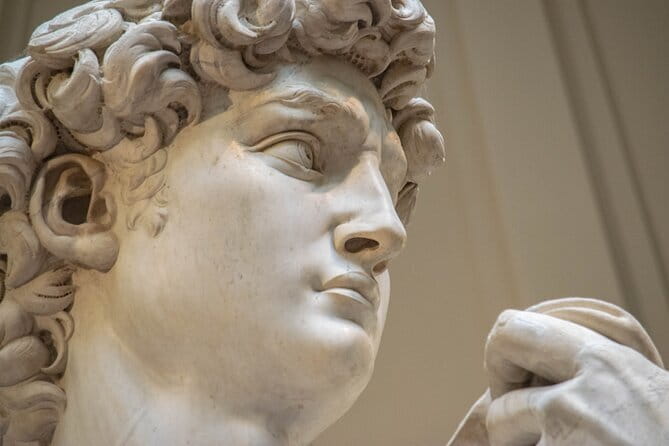
Stop 9 moves you to the Basilica di Santa Trinita, near Piazza Santa Trinita and close to Santa Trinita bridge. The tour notes its characteristic name pronunciation in the Florentine way (Trìnita), which is a fun detail, but the point is bigger: you’re stepping into another layer of Florence’s art and church evolution.
Here you do something important: you enter inside to see frescoes by Ghirlandaio. This is one of the few moments in the route where you get that “inside the artwork” payoff.
This is also where the tour starts shifting neighborhoods. Oltrarno has a different energy than the center you started in, and finishing later around Palazzo Pitti makes the Medici connection feel more grounded.
Palazzo Pitti: Medici to Grand Dukes to Royal Palace
Stop 10 is Palazzo Pitti, a huge Renaissance palace in Oltrarno, not far from Ponte Vecchio. The tour gives you the building’s timeline, which is the key to understanding why it matters.
The original nucleus dates to 1458 as the urban residence of banker Luca Pitti. Then the Medici purchased it in 1549, and it became the main residence of the grand dukes of Tuscany—first Medici, and later Habsburg-Lorraine from 1737. After Italy’s unification, it served as the royal palace for the House of Savoy during Florence’s brief years as the capital of the Kingdom of Italy (1865–70).
That timeline turns Palazzo Pitti into more than a large building. It becomes a map of power transitions in Florence.
Possible drawback: with only about 15 minutes, you won’t get a full “palace day.” Use this stop to decide if you want to come back for a longer visit later.
Church of Santa Felicita: Quiet Time Between Big Names
Stop 11 is the Church of Santa Felicita, located in Oltrarno between Ponte Vecchio and Palazzo Pitti. The tour frames it as one of the oldest churches in Florence and keeps the focus on the setting rather than only the fame.
This kind of stop is a nice reset. After Duomo and the major Renaissance palaces, Santa Felicita helps you breathe and notice Florence’s texture: smaller landmarks that still matter, even when they aren’t the main headline.
If your feet are getting tired, this is the kind of stop where you can slow down and absorb the neighborhood around it.
The Vasari Corridor: A Medici Escape Route in the Sky
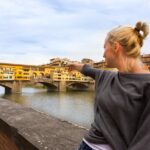
The final stop is the Vasari Corridor, an elevated passage connecting Palazzo Vecchio with Palazzo Pitti, passing through the Uffizi and crossing over Ponte Vecchio. The tour explains why it was built: so grand dukes could move freely and safely between residence and government palace, especially in a time when support for the new duke and new government could be uncertain after the Florentine Republic.
This is the “only in Florence” moment. You’re seeing architecture designed not for tourism, but for control, movement, and survival. It makes the whole Medici theme feel practical, not just historical.
Possible drawback: because it’s an elevated corridor, your ability to see details can depend on where you’re positioned during the stop. Go with the mindset that you’re learning the story and orientation, not hunting for every tiny architectural element.
Gelato, Bathroom Breaks, and Why Comfortable Shoes Are Non-Negotiable
The tour promises time for bathroom breaks, and some groups report a brief rest or coffee stop during the three hours. That’s not small stuff. Florence is a city where walking is the main activity, and small pauses keep your energy up for the later palaces.
Also: you’ll be on cobblestones and in and out of busy areas. The highlights explicitly recommend comfy walking shoes, and it’s advice worth taking seriously. Even a “3-hour” tour can feel longer when your feet are unhappy.
Finally, gelato is included as you stroll. It’s a nice way to keep the experience from feeling like a checklist. You’re still moving through the city, but with a reward that feels local and easy.
Price and Value: What $40.12 Buys You in Real Terms
At about $40.12 per person, you’re paying for three things:
- expert guidance that links the sights into one story,
- a route that saves you time deciding what to see first,
- and a structure that helps you move through Florence without getting lost in trivia.
The tour also lists admission ticket free for each of the featured stops, which improves value on paper because you’re not stacking ticket costs on top of the walking tour price.
Is it the cheapest way to see Florence? No. But it’s often one of the best ways to avoid the most common first-trip mistake: spending hours at famous places without understanding what you’re looking at. In a city like Florence, context is a currency, and this tour spends it well.
Who This Tour Is Best For (and Who Should Look Elsewhere)
This is a strong choice if:
- you’re short on time and want a high-impact orientation,
- you like architecture, churches, and the story behind artistic design,
- you want a guided route that ends in a great area for independent exploring,
- and you prefer small groups. The tour caps at 20, and some departures have run much smaller.
You might want a different plan if:
- you want long museum visits and detailed interior time at every stop,
- you dislike crowded central zones,
- or you need a slower pace with lots of sitting breaks.
For families too, it’s often a good format because it’s time-limited and story-driven. Reviews have mentioned adults and kids benefiting from the guide’s approach, and a small group makes questions easier.
Should You Book This Essential Florence Walking Tour?
I’d book it if you want Florence to make sense quickly. The route connects key landmarks across centuries, and you finish near Piazza della Signoria with real confidence about where to go next. The built-in breaks, gelato stop, and small-group feel are practical wins, not perks.
If you’re the type who wants to savor one museum for hours, then treat this as the warm-up, not the whole meal. But for most visitors—especially first-timers—this is one of the smarter ways to spend a morning in Florence.
FAQ
How long is the Florence walking tour?
The tour runs for about 3 hours.
Where does the tour start and end?
It starts at Piazza della Repubblica, 50123 Firenze FI, Italy, and ends at Piazza della Signoria (P.za della Signoria, 50122 Firenze FI, Italy).
What is the price per person?
The price is $40.12 per person.
How big are the groups?
The maximum group size is 20 travelers.
Is gelato included?
Yes. The tour overview includes tasting local gelato as you stroll.
Which main sights will we visit?
The route includes stops at Orsanmichele, Museo Casa di Dante, Duomo (Santa Maria del Fiore), the Baptistery of St. John, Campanile di Giotto, Santa Maria Novella, Palazzo Rucellai, Palazzo Strozzi, Basilica di Santa Trinita, Palazzo Pitti, Church of Santa Felicita, and the Vasari Corridor.
What happens if the weather is bad?
The experience requires good weather. If it’s canceled due to poor weather, you’ll be offered a different date or a full refund.
Can I cancel for a full refund?
Yes. Free cancellation is available up to 24 hours in advance for a full refund.
Are admissions included for the listed stops?
The itinerary lists admission ticket free for each of the stops.
You Might Also Enjoy
More Walking Tours in Florence
More Tours in Florence
- The Best tour in Florence: Renaissance & Medici Tales – guided by a STORYTELLER
★ 5.0 · 12,316 reviews

More Tour Reviews in Florence
- Tuscany Day Trip from Florence: Siena, San Gimignano, Pisa and Lunch at a Winery
★ 5.0 · 21,634 reviews - The Best tour in Florence: Renaissance & Medici Tales – guided by a STORYTELLER
★ 5.0 · 12,316 reviews