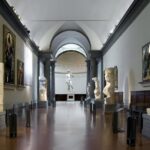
REVIEW · FLORENCE
Skip the Line: Florence’s Uffizi Gallery Guided Tour
Book on Viator →Operated by Ciao Florence Tours Srl · Bookable on Viator
Florence’s lines can steal your day. This skip-the-line Uffizi Gallery tour gets you inside fast, guided through the collection’s major turning points, then leaves you time to wander afterward on your own. It’s one of those rare museum experiences where the “logistics” matter almost as much as the art, because the Uffizi is famous for crowds.
I like two things here right away: the small group format (max 9) and the guide + audio headsets that help you keep up even when the rooms are packed. I also appreciate that the tour is built around the Uffizi’s oldest-to-newest flow, so you get a clear sense of how Renaissance art changed over time.
One possible drawback: 1 hour 45 minutes goes quickly, so if you’re hoping for every single heavyweight (like specific works not covered in the short route), you’ll still want your own extra hour or two after the tour to hit any favorites you missed. Language can also be a factor on especially busy days, since sound can be harder to catch in crowded galleries.
In This Review
- Key Highlights You’ll Actually Feel During the Tour
- Skip-The-Line Uffizi: Why It’s Worth Planning
- Where You Meet and How the Tour Starts Fast
- The 13th-Century to Renaissance Flow (And Why It Helps)
- Stop 1: Via Cavour and the Entry That Saves Your Energy
- Stop 2: 13th-Century Beginnings and the Giotto Turning Point
- Stop 3: Gothic Stories, Early Experiments, and Perspective
- Stop 4: Botticelli, Leonardo, and Michelangelo’s Most Famous Impact
- Stop 5: Three Giant Halls and the Big-Name Power Trio
- Price and What You’re Really Paying For ($58.52)
- When to Go: Timing Makes the Tour Feel Better
- Small Group Reality Check: The Most Common Friction Points
- Who This Uffizi Tour Is Best For
- Should You Book This Skip-the-Line Uffizi Tour?
- FAQ
- How long is the Uffizi guided tour?
- What is the meeting point?
- Where does the tour end?
- Does this tour include skip-the-line entry?
- Are entrance fees included?
- Is a mobile ticket used?
- How big is the group?
- What languages are offered?
- What should I bring or wear?
- Is there any entry delay on busy days?
Key Highlights You’ll Actually Feel During the Tour
- Skip-the-line entry that helps you avoid the longest waiting at the Uffizi door
- Headsets included, which makes the guide’s narration easier to follow in busy rooms
- A chronological walkthrough that tracks change from the 13th century through later Renaissance masters
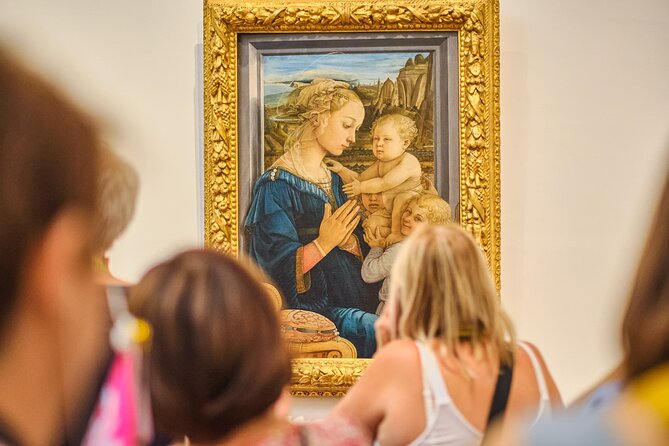
- Focus on crowd magnets like Botticelli’s Birth of Venus and Michelangelo’s Tondo Doni
- Then you’re free to stay inside after the guided portion and chase your own interests
Skip-The-Line Uffizi: Why It’s Worth Planning
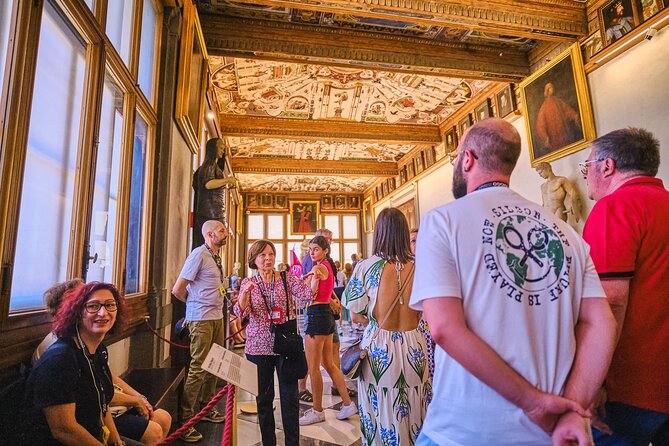
The Uffizi is the kind of museum where your day can get swallowed by queues. So when a tour promises skip-the-line access, that’s not a “nice extra.” It’s the difference between arriving fresh and arriving annoyed.
This experience has you meeting your fully licensed guide just outside the Uffizi area, then walking in with an entry ticket that gets you past the part where most people stall out. Your guided portion runs about 1 hour 45 minutes, which is long enough for context, not so long that you feel trapped in someone else’s route.
Two practical wins come from doing it this way. First, you’ll see key works while your attention is still sharp, not after hours of fatigue. Second, the guide helps you interpret what you’re looking at—especially useful when the Uffizi’s rooms feel like a maze of masterpieces.
That’s also why I like that the tour ends inside the museum. You’re not rushed out at the exact moment you start finding the paintings that pull you in. After the guided section, you can slow down and return to whatever grabbed you.
You can also read our reviews of more guided tours in Florence
- The Best tour in Florence: Renaissance & Medici Tales – guided by a STORYTELLER
★ 5.0 · 12,316 reviews
Where You Meet and How the Tour Starts Fast
The meeting point is near Via Camillo Cavour, 18 (the exact listing shows Co Re Com around that address). From there, you follow your guide toward the Uffizi—about a 15-minute walk.
This matters because Florence walking routes are simple, but timing is everything. If you’re running late, you risk losing your spot at the entry window. Plan to arrive early enough to use the bathroom, adjust your route, and be ready when the group gathers.
Once you’re at the museum entrance, the skip-the-line part takes over. The guide gets you inside, and you immediately start moving through galleries rather than waiting under the weight of other tourists’ plans.
Also note the group size: this is small (maximum 9 travelers). That’s a big deal at the Uffizi, where even “small groups” can stretch people thin if too many get funneled into the same narrow viewing spots.
The 13th-Century to Renaissance Flow (And Why It Helps)
The guided route follows a chronological logic—roughly from the 13th century through later periods—so you’re not just collecting famous paintings like postcards. You’re learning how style, storytelling, and technique changed.
You’ll notice this most in the way the guide frames each room. Instead of treating art like isolated masterpieces, the narration ties the works to the historical shifts that made the next style possible. That turns your museum visit into something closer to a guided “how did we get here?” lesson.
And because the Uffizi can be loud and crowded, the tour provides audio headsets for bigger groups. That’s not just comfort. It’s your ability to hear the guide clearly enough to connect one painting to the next.
The biggest strength of a structured tour is that it keeps you from getting lost in the endless choices. You’ll get the highlights and the context, then you’re released to explore what you personally want after.
Stop 1: Via Cavour and the Entry That Saves Your Energy
This is the setup stop, but it’s also where the tour earns its name. You start near Via Camillo Cavour, 18, meet your guide, then walk to the Uffizi. The walking time is about 15 minutes, so it’s not a long preamble.
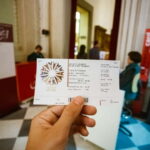
Then comes the payoff: you enter using the skip-the-line ticket. If you’ve ever watched people queue for what feels like forever in front of famous museums, you’ll immediately understand why I think this is the heart of the experience.
One small caution: on very busy days, there can be some short delays when entering the museum. It’s usually not a disaster, but it’s good to know it can happen if you’re traveling in peak season.
Stop 2: 13th-Century Beginnings and the Giotto Turning Point
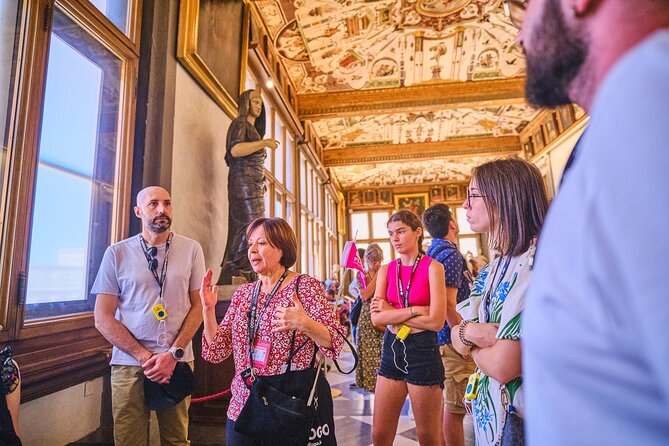
Your tour begins with works that reflect early Renaissance roots—especially the era where religious imagery dominates and technique starts shifting toward more depth and structure.
You’ll spend time around 13th-century works, including pieces featuring gold backgrounds and traditional themes like Madonna and Child. This sets up an important baseline: you’re seeing what artists looked like before the big leaps that later define the Renaissance.
Then the guide brings attention to a major shift attributed to Giotto, who helped move art toward more dimensional forms—less flat symbolism, more sense of volume and space. You don’t just memorize a name; you start noticing the difference in how figures occupy the painting.
If you’re the type who usually rushes through museums, this stop is useful because it gives you a “starting lens.” You learn what to look for before you hit the famous rooms full of Botticelli and Leonardo.
You can also read our reviews of more museum experiences in Florence


Stop 3: Gothic Stories, Early Experiments, and Perspective
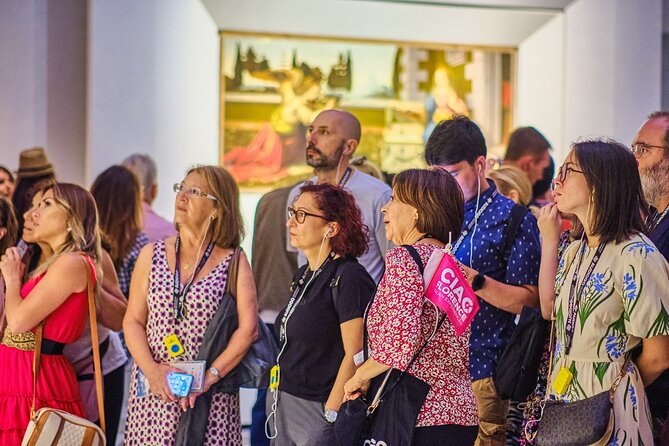
This part of the tour leans into the moment when artists start telling stories more clearly, instead of only presenting figures.
You’ll look at International Gothic works, with Adoration of the Magi by Gentile da Fabriano highlighted as a turning point. The narration emphasizes how art begins to move from simply showing people to arranging narrative scenes—so the painting reads like a story you can follow.
From there, you’ll move into experimentation with space and realism. A standout is Battle of San Romano by Paolo Uccello, where you can actually see the idea of three-dimensional space being tested.
The tour also points you toward works including:
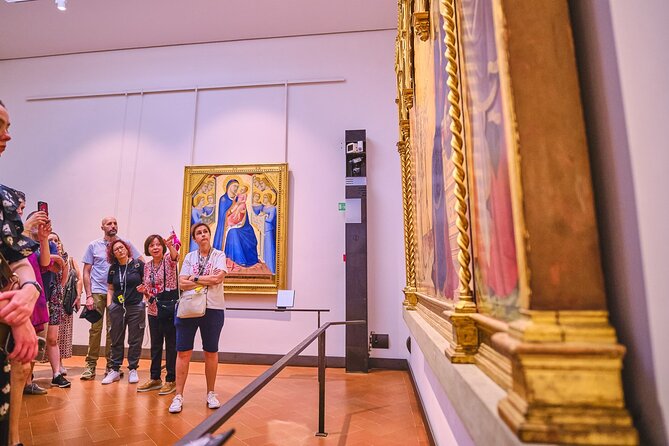
- Madonna with Child and Two Angels by Filippo Lippi
- Dukes of Urbino by Piero della Francesca
These choices help you understand why later geniuses like da Vinci and Raphael could build on what came before. You see the early steps: idealized faces, refined proportions, and compositional clarity.
The trade-off here is time. This is a “choose the path” stop. You’ll cover several names that matter, but not every adjacent painting in the same room. That’s why I recommend treating the guided time as your map, not your full checklist.
Stop 4: Botticelli, Leonardo, and Michelangelo’s Most Famous Impact
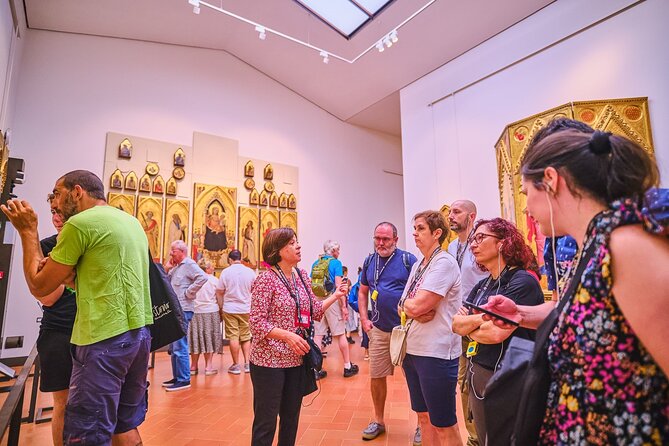
If the Uffizi were a concert, this is the headliner set.
Botticelli dominates, and the guide spends time on key works like The Birth of Venus and Primavera. You’ll also hear about Botticelli’s ties to the Medici family, which helps explain why these images mattered beyond art circles. When you understand who supported the work and why, the paintings feel less like random famous images and more like part of a real cultural project.
Then you’ll shift to Leonardo and Michelangelo. Even if you’ve seen reproductions in books, it hits differently to stand close to the actual paint and scale.
You’ll focus on:
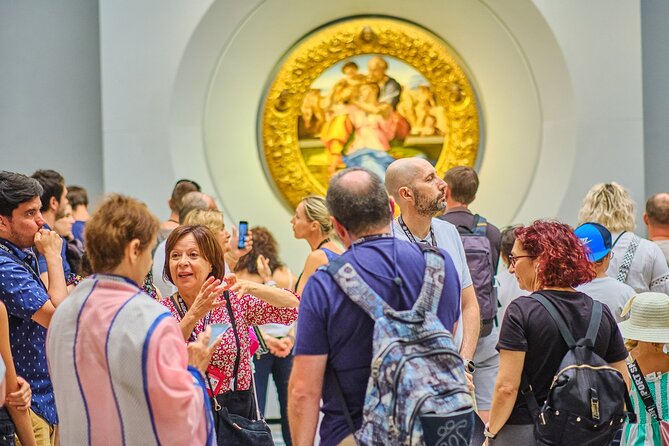
- Michelangelo’s Tondo Doni
- Leonardo da Vinci’s Baptism of Christ and The Annunciation
A useful detail: the tour notes that while some of these aren’t always the most widely known Leonardo and Michelangelo pieces, they still matter because the Uffizi places them in conversation with the surrounding artistic development. This is where the chronological approach pays off—you see how the museum “threads” these masterworks into the story of Renaissance art.
If you’re short on time in Florence, this guided stop is one of the best ways to make sure you leave with more than surface-level fame.
Stop 5: Three Giant Halls and the Big-Name Power Trio
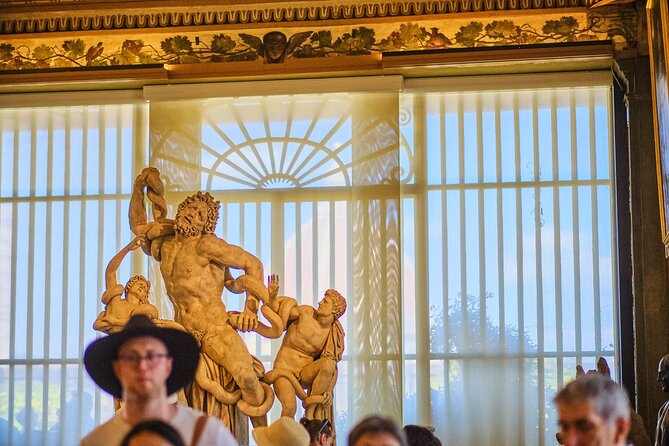
The last segment leads you through larger halls filled with major artists: Raphael, Titian, and Caravaggio. The idea here is scale. You’re no longer in intimate viewing mode; you’re dealing with museum rooms designed to hold a dense concentration of masterpieces.
This part is great if you like questions and back-and-forth with your guide. The format gives you time to ask about what you’re seeing, and the guide’s narration can connect stylistic choices to the artists’ lives and the broader evolution of painting.
After this guided portion ends, you’re free to keep exploring at your own pace. That’s the moment to slow down. Use the guide’s route as your first pass, then return to your personal favorites without feeling like you’re “behind.”
Price and What You’re Really Paying For ($58.52)
At $58.52 per person for about 1 hour 45 minutes, the value comes from what’s included, not the sticker price.
Included items that genuinely help:
- Skip-the-line access, which saves you the biggest time sink at the Uffizi
- A professional, fully licensed guide
- Entrance fees included
- Audio headsets, so you can actually hear the commentary
- A small group tour, max 9, which helps you move and focus without constant shoulder-to-shoulder stress
What’s not included is hotel pickup and drop-off. In Florence, that’s normal, and it usually keeps the cost reasonable. You just need to plan your own arrival at the meeting point near Via Camillo Cavour.
I also like that the tour gives you enough structure to feel productive, but doesn’t lock you inside forever. Your time after the guided portion is where you can turn the “great overview” into a personal visit.
When to Go: Timing Makes the Tour Feel Better
You’ll see mention of doing it early, and I agree with the logic. Even with skip-the-line access, the galleries themselves can get busy fast.
This is also why you should wear comfortable walking shoes. The Uffizi involves plenty of moving between rooms, and if your feet are unhappy, your attention drops.
As for season and languages: from November to March, the tour is always confirmed in English and Spanish, and minimum group size is mentioned for other languages (Italian, French, German require 4 people). From April to October, the tour runs in a monolingual small group format.
So if you care about language precision, double-check the seasonal detail when booking, and don’t assume you’ll always hear the same language every day.
Small Group Reality Check: The Most Common Friction Points
The biggest strength here—small group size—also creates some expectations.
If your group is small, it’s easier to hear explanations and ask questions. If you happen to land in a situation where audio or accent makes it hard to follow, you might feel like you missed a portion of the art interpretation. That’s not a guaranteed issue, but it’s worth flagging as a possible drawback.
Also, the 1 hour 45 minutes format means you won’t get every possible masterwork. One of the most repeated critiques is that the tour can feel too short if you’re expecting every famous artist covered equally, including some big names that may not get the spotlight during this particular route.
So go in with the right mindset:
- Let the tour give you the map and the major context
- Then stay longer after if you have the energy (and it helps if you know what you want to see before you arrive)
Who This Uffizi Tour Is Best For
This tour is a strong fit if you:
- Want skip-the-line entry because crowds are draining for you
- Like a guided route that explains why paintings matter, not just what they’re called
- Prefer a small group with time to ask questions
- Are visiting for a limited time and want the Uffizi’s strongest highlights covered efficiently
It’s also ideal if you’re returning later to specific favorites, because you’ll know where to go next once the guide’s route is done.
If you’re the kind of traveler who likes to wander with zero structure, you could still enjoy the Uffizi independently. But if you want the Uffizi to make more sense quickly, this format does that job well.
Should You Book This Skip-the-Line Uffizi Tour?
I’d book it if your priority is getting inside quickly, hearing clear commentary with headsets, and covering the museum’s most famous turning points in a tight, manageable route. The combination of skip-the-line access + small group + included entry and audio is exactly what makes this type of tour feel “worth it,” not just convenient.
I wouldn’t book it as your only Uffizi plan if you want a deep, do-it-all checklist of every famous artist. Treat it as your first visit pass. Then give yourself extra time afterward to re-see what you loved.
If you can, aim for an earlier time slot and come ready to focus. The Uffizi rewards that. And once you’ve gotten the structure from your guide, you’ll have an easier time choosing what to linger on when you’re walking the galleries solo.
FAQ
How long is the Uffizi guided tour?
The tour lasts about 1 hour 45 minutes.
What is the meeting point?
You meet near Via Camillo Cavour, 18 (Co Re Com) in Florence.
Where does the tour end?
The tour ends inside the Uffizi Gallery.
Does this tour include skip-the-line entry?
Yes. The experience includes skip-the-line access into the Uffizi Gallery.
Are entrance fees included?
Yes. Entrance fees are included, and audio headsets are provided.
Is a mobile ticket used?
Yes. The tour provides a mobile ticket.
How big is the group?
The maximum group size is 9 travelers.
What languages are offered?
From November to March, the tour is confirmed in English and Spanish (and other languages have minimum participant requirements). From April to October, it runs in a small group with a monolingual format.
What should I bring or wear?
Wear comfortable walking shoes. Your route includes walking and moving between galleries.
Is there any entry delay on busy days?
On the busiest days, there may be short delays entering the museums, even with the skip-the-line setup.
You Might Also Enjoy


More Guided Tours in Florence
- The Best tour in Florence: Renaissance & Medici Tales – guided by a STORYTELLER
★ 5.0 · 12,316 reviews
More Tours in Florence
- The Best tour in Florence: Renaissance & Medici Tales – guided by a STORYTELLER
★ 5.0 · 12,316 reviews



More Tour Reviews in Florence
- Tuscany Day Trip from Florence: Siena, San Gimignano, Pisa and Lunch at a Winery
★ 5.0 · 21,634 reviews - The Best tour in Florence: Renaissance & Medici Tales – guided by a STORYTELLER
★ 5.0 · 12,316 reviews