REVIEW · FLORENCE
Leonardo Da Vinci Museum Entrance Ticket
Book on Viator →Operated by Museo Le Macchine di Leonardo da Vinci · Bookable on Viator
Da Vinci fans, this one’s practical. You’re paying for skip-the-line entry into a compact museum packed with working models of Leonardo’s inventions. It’s also a smart choice when you want something different from the usual art stops.
Two things I like a lot: the size and focus (over 50 models in four rooms, many genuinely working) and the family-friendly layout (kids’ areas and interactive elements). One thing to consider: the experience leans more toward models and recreations than original Leonardo artifacts, so adults looking for deep art history may feel it’s lighter than expected.
In This Review
- Key things to know before you go
- Leonardo da Vinci Museum Entrance Ticket in Florence: What You’re Really Buying
- Ticket value: Why $12.55 feels fair (or not) depending on your mood
- Getting in smoothly: Timing, group size, and how to plan your day
- Stop inside Museo Le Macchine: Your 4-room walkthrough of Leonardo’s ideas
- Civil machines room: The engineering side that surprises people
- Flying machines room: Where imagination meets real mechanics
- War machines room: Darker topics, sharper design thinking
- Anatomy models room + the documentary: A calmer way to wrap up
- Hands-on moments and interactive displays: Fun for families, mixed for adult expectations
- Where to eat and what to buy inside: Caffé Michelangiolo and the shop
- Florence logistics: How long it really takes and where it fits best
- Who should book this ticket (and who might want to rethink it)
- A smart caution: double-check the city before you pay
- Should you book the Leonardo da Vinci Museum entrance ticket in Florence?
- FAQ
- What is the price for the Leonardo da Vinci Museum entrance ticket in Florence?
- How long does the visit usually take?
- What’s included with the ticket?
- Are food and drinks included?
- Is the experience offered in English?
- What are the opening hours?
- Can I cancel for free?
Key things to know before you go
- Timed entry with flexible slots helps you avoid the worst waiting
- 50+ models arranged in four themes: civil, flying, war, and anatomy
- Mostly working machines, not just static displays
- A documentary on Leonardo runs on large screens as you walk
- Caffé Michelangiolo is inside the exhibition area, plus a bookstore for souvenirs
Leonardo da Vinci Museum Entrance Ticket in Florence: What You’re Really Buying
This entrance ticket gets you into the Museo Le Macchine di Leonardo da Vinci, located in the Galleria Michelangelo area in Florence’s city center. The museum’s entire pitch is simple: see how Leonardo thought, designed, and tested ideas that still feel futuristic.
The setting is part of the hook. The museum sits in the same broader Galleria Michelangelo area where the Macchiaioli used to meet—so while you’re inside, you’re also in a place tied to Florence’s creative energy. That gives the visit a bit more weight than a random stop in a shopping street.
In plain terms, you’re buying time. The ticket is meant to help you get in without losing a big chunk of your day to lines, and the museum keeps the visit moving at a comfortable pace.
You can also read our reviews of more tours and experiences in Florence


Ticket value: Why $12.55 feels fair (or not) depending on your mood
At $12.55 per person, this is one of the better-value “special interest” tickets in Florence. That’s because the museum is short enough to fit into a packed itinerary—about 1 hour to 1 hour 30 minutes—yet it contains enough variety to feel complete, even if you only have a small window.
Where the value lands depends on what you came for:
- If you’re excited by engineering ideas, mechanics, and how drawings can turn into physical devices, you’ll likely feel it’s a great deal.
- If you wanted original Leonardo artifacts (not models and replicas), you might judge it as pricey for what you see.
The museum clearly leans into hands-on inspiration. You’ll see interactive elements and working-style demonstrations, plus you can browse a bookstore afterward. It’s also small, which tends to keep the experience from dragging.
Getting in smoothly: Timing, group size, and how to plan your day
This ticket experience offers flexible time slots throughout the day, with opening hours from 10:00 AM to 6:00 PM (daily, Monday–Sunday). The overall idea is: pick a slot that fits your Florence rhythm, then use your time inside without racing.
A small detail that matters: the experience lists a maximum of 20 travelers. Smaller groups usually mean you’re less likely to feel trapped behind a crowd while you read labels or watch working models.
Also, it’s near public transportation, so it’s easier to plug into a day that starts in the center and then breaks out toward other sights. I’d treat it like a mid-morning or early-afternoon stop, when you still have energy to read and look closely.
Stop inside Museo Le Macchine: Your 4-room walkthrough of Leonardo’s ideas
You enter and start in the Museo Leonardo Da Vinci space where the machines are organized into four themed rooms. The whole place is designed like a mini “concept tour” of Leonardo’s interests, rather than a chronological museum of his entire life.
Here’s what makes this layout work for you:
- You don’t have to think like a historian. You can follow the themes.
- Each room narrows your focus, so the exhibits feel less overwhelming.
- You get a mix of visual explanations and working demonstrations.
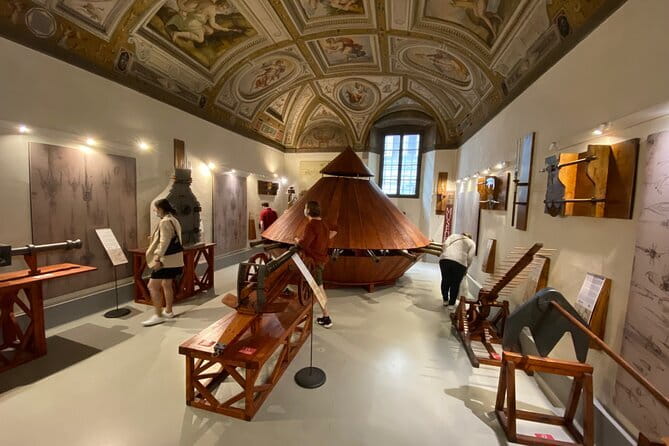
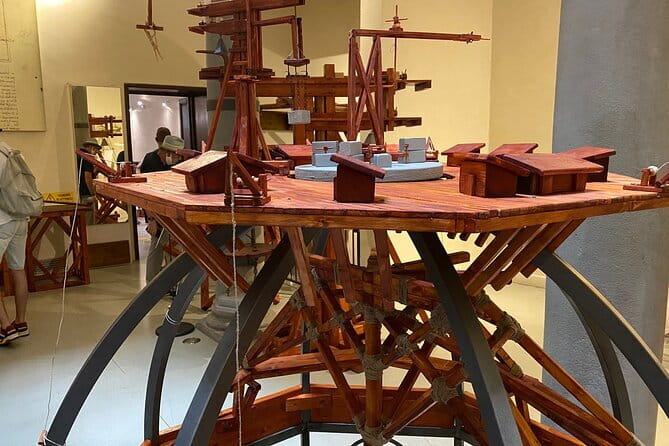
The museum displays more than 50 models across four rooms. The largest room focuses on civil machines. Then you move into flying machines. After that come war machines. Finally, the fourth room is home to a more recently developed collection of anatomical models.
Most of the models are not just pretty props. They’re presented as real working machines, which is why this museum often hits harder than the typical “look but don’t touch” display.
Civil machines room: The engineering side that surprises people

In the first and largest room, you’ll see civil machines—Leonardo’s ideas for engineering problems in everyday life and practical tasks. This is often where first-time visitors get a jolt, because it reminds you Leonardo wasn’t only about art or famous paintings.
If you like understanding how systems work, take your time here. The civil machines tend to feel grounded. You’ll see concepts translated into devices, and that makes the exhibit feel like engineering, not just history.
A small practical tip: don’t speed through. Labels and diagrams help you connect what you’re looking at with what Leonardo was trying to solve.
You can also read our reviews of more museum experiences in Florence



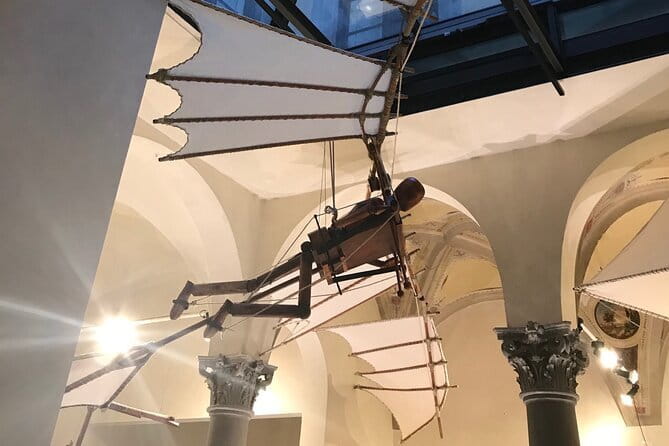
Flying machines room: Where imagination meets real mechanics
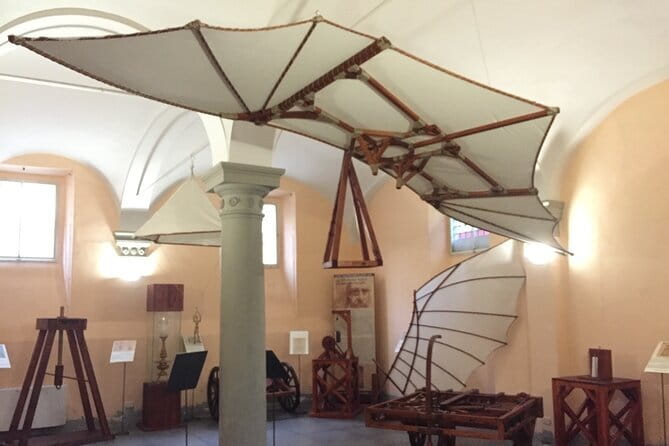
Next is the flying machines room. This is the area that tends to pull you forward—because you’re looking at ideas that sound impossible, then watching models that attempt to bring them closer to reality.
The value here isn’t just the subject matter. It’s the way the museum frames Leonardo’s thinking as a mixture of observation and experimentation. Flying becomes a pathway into physics and design logic.
If you’re visiting with kids, this room is often a strong energy boost: it’s easier to stay interested when the topic is dramatic, visual, and full of “how could this possibly work?” moments.
War machines room: Darker topics, sharper design thinking
The war machines room shifts tone. It’s not cozy. But it’s also where you’ll see Leonardo’s ability to think in problem-solving terms, including strategy and mechanics.
Just remember this is a museum about inventions, not a moral debate. You’ll be focused on engineering concepts and how designs can be built and tested.
If you’re traveling with teens or older kids, this room can spark questions about why invention and ethics are always connected—even centuries later.
Anatomy models room + the documentary: A calmer way to wrap up
The final room is built around anatomical models, described as recently developed. This part of the museum is a good counterbalance to the more mechanical rooms. It shifts from devices to the human body, which matches Leonardo’s reputation for study and observation.
As you move through, you’ll also encounter a documentary on Leonardo’s life and works displayed on large screen monitors. It’s not just background noise. It helps you connect the machines to broader themes—so the visit doesn’t feel like a pile of cool gadgets with no story.
If you’re the type who likes to understand context after you’ve seen the objects, spend a few extra minutes near the screens. Let the documentary act like glue.
Hands-on moments and interactive displays: Fun for families, mixed for adult expectations
This museum is very friendly to curious minds. Many exhibits include interactive elements, and there are hands-on activities, including space for children.
Some of the feedback you’ll see leans strongly positive on the interactive side. One recurring theme is that the museum makes you feel like you’re engaging with a genius’s work, not just reading about it. The kids’ areas and the ability to interact are major reasons families tend to enjoy the visit.
That said, there are also cautionary notes you should keep in mind:
- Some interactive parts may not be as satisfying if you expect touchscreens and deep activities at every turn.
- A common complaint is that some exhibits feel like replicas or basic models rather than museum-grade, original artifacts.
My advice: treat this as a “machines and ideas” museum. If you’re coming with that mindset, the interactive approach is usually a win.
Where to eat and what to buy inside: Caffé Michelangiolo and the shop
Inside the exhibition area, there’s an agreement with Caffé Michelangiolo, a restaurant where you can grab food and drinks. Those aren’t included with your entrance ticket, so you’ll want to plan for a quick snack or sit-down break if you’re visiting during peak meal times.
There’s also a bookshop. You’ll find publications and gadgets, which can be a fun way to turn what you saw into something you can revisit later. It’s also useful for picking up educational materials if you’re traveling with kids.
A practical plan: set aside about 60–90 minutes for the exhibits, then add 10–20 minutes if you want food or browsing time.
Florence logistics: How long it really takes and where it fits best
The museum typically works out to 1–1.5 hours, and that length is a big advantage in Florence. You can fit it between bigger sights without your day turning into a sprint.
It also helps that it’s located in the city center, near public transportation. That means you can move there without needing a complicated route.
If you’re building a route, I’d do this:
- Aim for a time when you want an indoor break or a change of pace.
- Plan your next outdoor stop right after, so you don’t get “stuck inside too long.”
The building is also described as comfortable and visually pleasant, with mentions of painted ceilings that add character beyond the exhibits themselves.
Who should book this ticket (and who might want to rethink it)
This is a great match if you like:
- Engineering concepts and machines
- Interactive displays
- Leonardo as an inventor first, not just an artist
It’s also a strong family option because the museum includes kids areas and interactive activities. If you have children who get restless during long art galleries, this tends to hold attention better than museums that are mostly paintings and quiet rooms.
You may want to reconsider if you’re chasing:
- Authentic original Leonardo artifacts
- Deep, immersive storytelling throughout every room
- Lots of hands-on experimentation at every stop
In short: come for the inventions and mechanics, not for an art museum experience.
A smart caution: double-check the city before you pay
One theme that pops up in real-world ticket problems is confusion between Leonardo museums in different Italian cities. Before you confirm anything, check that your ticket is for the Florence Leonardo da Vinci Museum you intend to visit. If you’re bouncing between cities on the same trip, this is the one step that prevents a lot of frustration.
Should you book the Leonardo da Vinci Museum entrance ticket in Florence?
Yes—if you want a short, focused stop that feels different from the usual Florence classics, this ticket is a solid buy. The combination of timed entry, a compact 4-room layout, and over 50 working-style machine models makes it easy to justify the cost for what you get.
I’d say book it especially if you’re traveling with kids, teens, or anyone who likes science and how things work. For adult art lovers who want originals and deeper art context, it might still be enjoyable, but your expectations should shift toward machines and ideas rather than paintings.
If your schedule is tight, treat this as an efficient indoor win: you’ll come out feeling like Leonardo wasn’t just a painter—he was a full-on inventor.
FAQ
What is the price for the Leonardo da Vinci Museum entrance ticket in Florence?
The price is $12.55 per person.
How long does the visit usually take?
Plan for about 1 hour to 1 hour 30 minutes.
What’s included with the ticket?
The ticket includes admission to the Leonardo da Vinci Museum.
Are food and drinks included?
No. Food and drinks are not included, though there is a Caffé Michelangiolo restaurant inside the exhibition area.
Is the experience offered in English?
Yes, it is offered in English.
What are the opening hours?
Daily hours are listed as 10:00 AM to 6:00 PM (Monday through Sunday), within the date range shown.
Can I cancel for free?
Yes. Free cancellation is available up to 24 hours in advance for a full refund.
You Might Also Enjoy
More Museum Experiences in Florence
More Tickets in Florence


More Tour Reviews in Florence
- Tuscany Day Trip from Florence: Siena, San Gimignano, Pisa and Lunch at a Winery
★ 5.0 · 21,634 reviews - The Best tour in Florence: Renaissance & Medici Tales – guided by a STORYTELLER
★ 5.0 · 12,316 reviews