REVIEW · FLORENCE
Dan Brown’s INFERNO Walk with a Local
Book on Viator →Operated by LocalBini - The go-to platform for Experiences by Locals in Europe · Bookable on Viator
Florence gets extra dark on this walk. I like the small-group pace and the way the route points you toward Inferno-style connections across major landmarks. One thing to watch: the story tie-ins (and even how long you spend near Boboli Gardens) can vary depending on the guide and the exact flow of the tour.
This is a 90-minute, on-foot experience that starts at Fontana del Porcellino and ends at Boboli Gardens. I also appreciate that guides named in past runs include Rita and Mattia—both associated with strong storytelling and Florence context—so you’re not just getting a memorized script.
If you’re the type who wants the book front and center the whole time, plan to ask questions and keep expectations flexible. You’ll still see big-hitter Florence sites up close, but the emphasis on Dan Brown can be heavier or lighter depending on the day.
In This Review
- Key highlights to know before you go
- Florence with a plot twist: what this Inferno walk really delivers
- Meeting at Fontana del Porcellino: the myth-based warmup
- Medici settings and Michelangelo’s New Sacristy: where power becomes art
- A marble-facade church stop: history you can actually picture
- A palace-turned-art-museum moment: real Florence over postcard Florence
- Loggia dei Lanzi and the sculpture air: Renaissance art outdoors
- Ponte Vecchio, the covered bridge, and Roman-origin roots
- The royal palace story and the Boboli Gardens finale
- How the guide connects the sites to Inferno (and when it can wobble)
- Price and value in Florence: what you’re paying for
- Who should book this walk
- Quick reality check: what to do before you go
- Should you book this Inferno walk in Florence?
- FAQ
- How long is Dan Brown’s INFERNO Walk with a Local?
- Where does the tour start and end?
- How big is the group?
- Is Dan Brown actually part of the tour, or is it mostly sightseeing?
- What’s included in the ticket price?
- Are snacks or drinks included?
- Can I cancel if my plans change?
- Is it suitable for most people, and can service animals join?
Key highlights to know before you go
- Fontana del Porcellino start: start right where the bronze boar tradition begins, near Piazza del Mercato Nuovo
- Medici tomb stop: the tour includes the Medici setting, including Michelangelo’s New Sacristy
- Loggia dei Lanzi sculpture views: open-air Renaissance statues come into play during the walk
- Ponte Vecchio crossing: you’ll cross the iconic covered bridge on a route with Roman-era roots
- Boboli Gardens finale: the experience ends in the gardens with Renaissance statues and ornate fountains
- Very small group: capped at 8 travelers, so you should be able to hear your guide and ask questions
Florence with a plot twist: what this Inferno walk really delivers
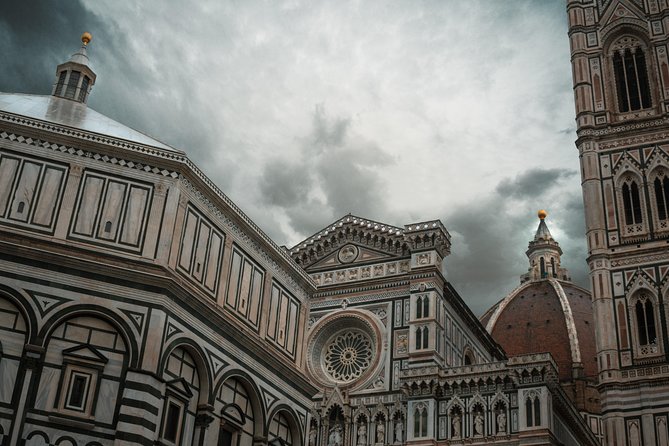
Dan Brown’s Inferno is the hook, but the payoff is Florence itself. Instead of treating the city like a checklist, this walk uses the book’s lens to help you notice the city’s symbols, power centers, and art made for lasting fame.
I especially like how practical the format is: a guided, intimate stroll of about 1 hour 30 minutes, with enough time to ask what you’re seeing. And because it’s capped at a small size (with the experience described as limited to just a few people), you’re less likely to get lost in a crowd.
The one drawback I’d flag is expectation management. Some runs lean more toward book-and-film references than others, and if you’re buying this strictly for wall-to-wall Dan Brown storytelling, you might feel the connection isn’t constant.
You can also read our reviews of more tours and experiences in Florence.
- Tuscany Day Trip from Florence: Siena, San Gimignano, Pisa and Lunch at a Winery
★ 5.0 · 21,634 reviews


Meeting at Fontana del Porcellino: the myth-based warmup
The tour begins at the Fontana del Porcellino in Piazza del Mercato Nuovo. This is a strong opening point because it’s central, easy to find, and instantly gives Florence a character that feels half real, half legend.
You’ll get the classic tradition prompt: rub the boar’s snout for luck and a return to Florence some day. It’s a small moment, but it sets the tone—this walk isn’t only about monuments, it’s about Florence as story.
From here, you’ll start working your way through the power-and-art spine of the city, which is a good fit for the Inferno framing. The guide’s job is to connect what you’re seeing to the larger themes the book uses—politics, patronage, religion, and art made to communicate.
Medici settings and Michelangelo’s New Sacristy: where power becomes art
One of the biggest stops is the domed landmark tied to Medici tombs, including Michelangelo’s New Sacristy. Even if you don’t know the book, this is a Florence anchor because it’s where patronage turns into unforgettable sculpture and funerary symbolism.
What I like about including this in a walk like this is simple: it gives you context fast. When you understand who commissioned what—and why—you start reading the buildings differently. The guide’s job is to help you see the city not as a museum grid, but as a network of influence.
If you’re a Dan Brown fan, this type of stop is also where literary connections often feel most believable. The Medici story is already dramatic in real life, so when the guide ties it back to Inferno, the narrative doesn’t feel forced.
A marble-facade church stop: history you can actually picture
Next up is an octagonal basilica with a striking marble facade—built to make an impression. This kind of architecture is hard to appreciate from selfies alone, because the details are what communicate the message.
On this walk, the value is that you’ll get the history behind what you’re looking at: what the facade signals, how the space is organized, and why the style matters. Florence has plenty of ornate churches, but this one gives you a strong visual reference point for the story lens.
If you’re hoping for constant Dan Brown nods at every stop, this is still a place where you can get your interest back quickly. The architecture is vivid enough that even when the book reference fades for a minute, the stop still lands.
A palace-turned-art-museum moment: real Florence over postcard Florence
The itinerary also includes a 13th-century palace now functioning as an art museum. I like this stop because it shifts the tone from church grandeur to the lived world of art and display inside civic spaces.
Palaces in Florence aren’t only about wealth; they show how art was used to communicate status and identity. In a walk structured around Inferno, that matters, because the book’s themes lean heavily on secrecy, legacy, and the way institutions shape knowledge.
One practical note: museum interiors can mean more standing and less flexibility than outdoor stops. If you’re traveling with anyone who gets tired quickly, it’s worth noting this segment is part of the 90-minute flow.
- The Best tour in Florence: Renaissance & Medici Tales – guided by a STORYTELLER
★ 5.0 · 12,316 reviews





Loggia dei Lanzi and the sculpture air: Renaissance art outdoors
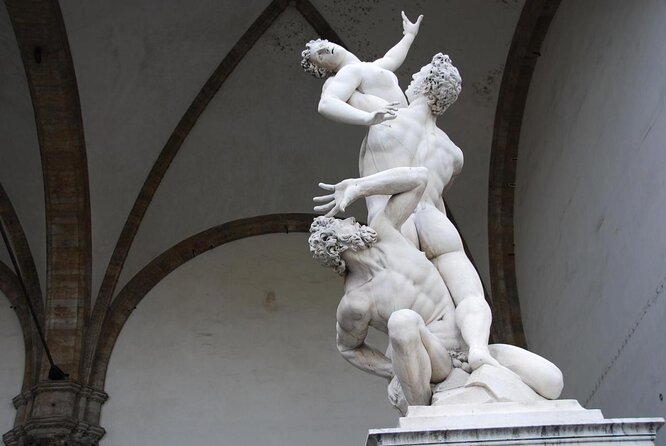
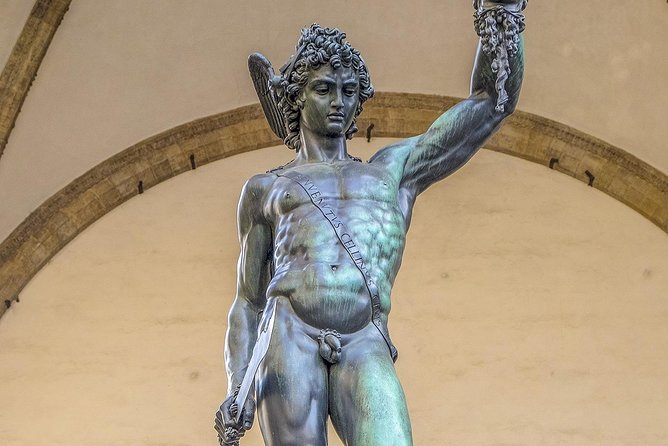
You’ll also stop at the Loggia dei Lanzi, a 14th-century ceremonial building with an open-air gallery of Renaissance sculptures. This is a great mid-tour reset because you can breathe, look across the sculptures, and connect the artworks to the guide’s storytelling.
For Inferno fans, outdoor sculpture stops tend to work well because the setting is naturally symbolic: public art, power displayed where people can see it, and craftsmanship meant to outlast the moment.
I’d consider this one of the tour’s strongest values. A short stop can still teach you how to “read” the sculptures instead of just admiring them. If your guide makes the connections well, this is where the walk starts to feel like your own personal guided chapter.
Ponte Vecchio, the covered bridge, and Roman-origin roots
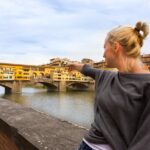
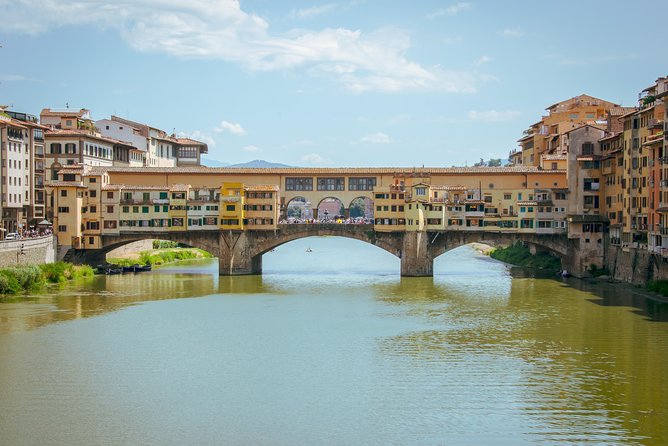
Another highlight is walking down the legendary medieval arched river bridge with Roman origins. Ponte Vecchio is famous for a reason, but the deeper value here is the way a local frames its long timeline.
Crossing it on foot inside a guided route means you’ll get more than the classic view. You’ll also get context on how the bridge evolved and why Florence valued that crossing so much across centuries.
And yes, it still feels like Florence. The shops and the river bends create that cinematic, slow-motion effect even when you’re moving at walking speed. The guide’s perspective helps you notice the details that you’d otherwise gloss over.
The royal palace story and the Boboli Gardens finale

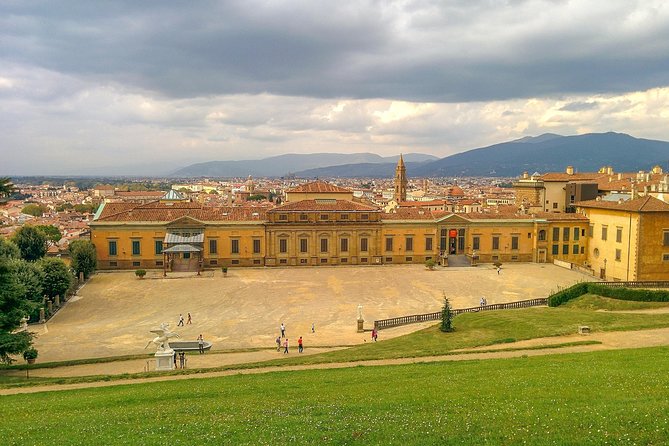
The walk includes a stop where you’ll learn the history behind a magnificent Renaissance royal palace. This is important because Boboli Gardens don’t feel like a random park. They’re tied to the world of Medici power, status, and curated taste.
Then the tour concludes in Boboli Gardens, with Renaissance statues and ornate fountains. Ending in the gardens is a smart choice: you finish in a place where art and landscape design blend into something you can actually wander through after the tour ends.
That said, I’d take one real caution seriously. Some people reported missing the gardens—or getting a shorter look than they expected. So if Boboli Gardens is the main reason you booked, don’t assume you’ll have long, unhurried time inside. Ask the operator ahead of time what the gardens stop time looks like for your chosen departure.
How the guide connects the sites to Inferno (and when it can wobble)
This tour lives and dies by the guide’s focus. The experience is designed to explore Florence through the lens of Dan Brown’s Inferno, and at least some guides are described as true Inferno aficionados with verified knowledge about book and city connections.
When the guide nails it, you get more than “this is Michelangelo.” You get why it matters to the story themes and what details you should notice. This is also where a guide like Mattia or Rita becomes a real deciding factor—when storytelling is strong, it turns a landmark-heavy route into a coherent narrative walk.
When it doesn’t land, the problems are usually practical:
- The novel connection can be only occasional rather than constant.
- You might have moments where the guide walks ahead, making it harder to hear explanations.
My advice: if Dan Brown connections are your top priority, plan to ask direct questions early. You can also set a quick expectation with the guide at the start: you’re interested in how the sites relate to the plot beats, not only the architecture.
Price and value in Florence: what you’re paying for
At $161.44 per person for about 1 hour 30 minutes, this isn’t a budget stroll. But the value isn’t only “time with a guide.” It’s time with a local who can connect major landmarks into a story-driven route.
You’re also paying for a small group, which usually means:
- better back-and-forth questions
- less time squeezed into a mass group
- a smoother flow between stops
If your group size is larger, the tour’s “group discounts” feature could help. Still, for a single traveler, the best value comes when you’re the kind of person who enjoys interpretation—someone pointing out what to notice, not only where to stand for photos.
Given the mixed feedback about story emphasis and garden time, I’d treat this as an experience you’ll enjoy most if you’re flexible and curious. If you want a guaranteed, constant Dan Brown lecture, you’ll need to confirm how the guide structures the connections for your specific departure.
Who should book this walk
This is a strong fit if:
- You know and love Inferno and want Florence landmarks explained through that lens
- You like small-group walking tours more than crowded bus-style touring
- You want a route that hits major sites quickly—Medici-related stops, Ponte Vecchio, sculpture views, and the Boboli Gardens finish
It may be less ideal if:
- You want Boboli Gardens as a long, detailed wandering visit
- You prefer a guide who ties the plot to every single stop, every single time
- You dislike tours where you might have to ask for more explicit connections
Quick reality check: what to do before you go
You’ll enjoy the experience more if you do two tiny pre-game steps:
- Refresh your memory of the parts of Inferno you care about most, so you can ask targeted questions.
- Bring your own water plan and light snacks because nothing is included for food or drinks.
Also, give yourself a little margin on the meeting point. Starting at Fontana del Porcellino in the Piazza del Mercato Nuovo is convenient, but Florence is always busy, and you don’t want to feel rushed before the tour even starts.
Should you book this Inferno walk in Florence?
I think you should book it if Inferno is your entry point to Florence and you’re excited by the idea of a local guiding you through symbols of power, art, and faith. The small-group format, the Medici/Michelangelo stop, the Ponte Vecchio crossing, and the Boboli Gardens finale are enough to make the walk worthwhile even if the book tie-ins aren’t equal at every moment.
I’d think twice or at least message the operator first if your top priority is a full-length, uninterrupted Dan Brown narrative or a long Boboli Gardens immersion. This tour seems capable of delivering a great story-led experience, but the garden time and the level of story emphasis can shift depending on how the day is run.
FAQ
How long is Dan Brown’s INFERNO Walk with a Local?
It lasts about 1 hour 30 minutes.
Where does the tour start and end?
It starts at Fontana del Porcellino in Piazza del Mercato Nuovo, and it ends at Boboli Gardens.
How big is the group?
The experience has a maximum of 8 travelers, and it’s described as an intimate tour with a small number of people.
Is Dan Brown actually part of the tour, or is it mostly sightseeing?
The tour is designed to explore Florence through the lens of Dan Brown’s Inferno. The guide is described as having verified knowledge about the book and its connections to Florence.
What’s included in the ticket price?
You get a local guide for the walking tour, and there is a mobile ticket.
Are snacks or drinks included?
No. Snacks, food, and drinks are not included.
Can I cancel if my plans change?
Yes. Free cancellation is available up to 24 hours in advance for a full refund.
Is it suitable for most people, and can service animals join?
Most travelers can participate, and service animals are allowed.
You Might Also Enjoy


More Tour Reviews in Florence
- Tuscany Day Trip from Florence: Siena, San Gimignano, Pisa and Lunch at a Winery
★ 5.0 · 21,634 reviews - The Best tour in Florence: Renaissance & Medici Tales – guided by a STORYTELLER
★ 5.0 · 12,316 reviews